
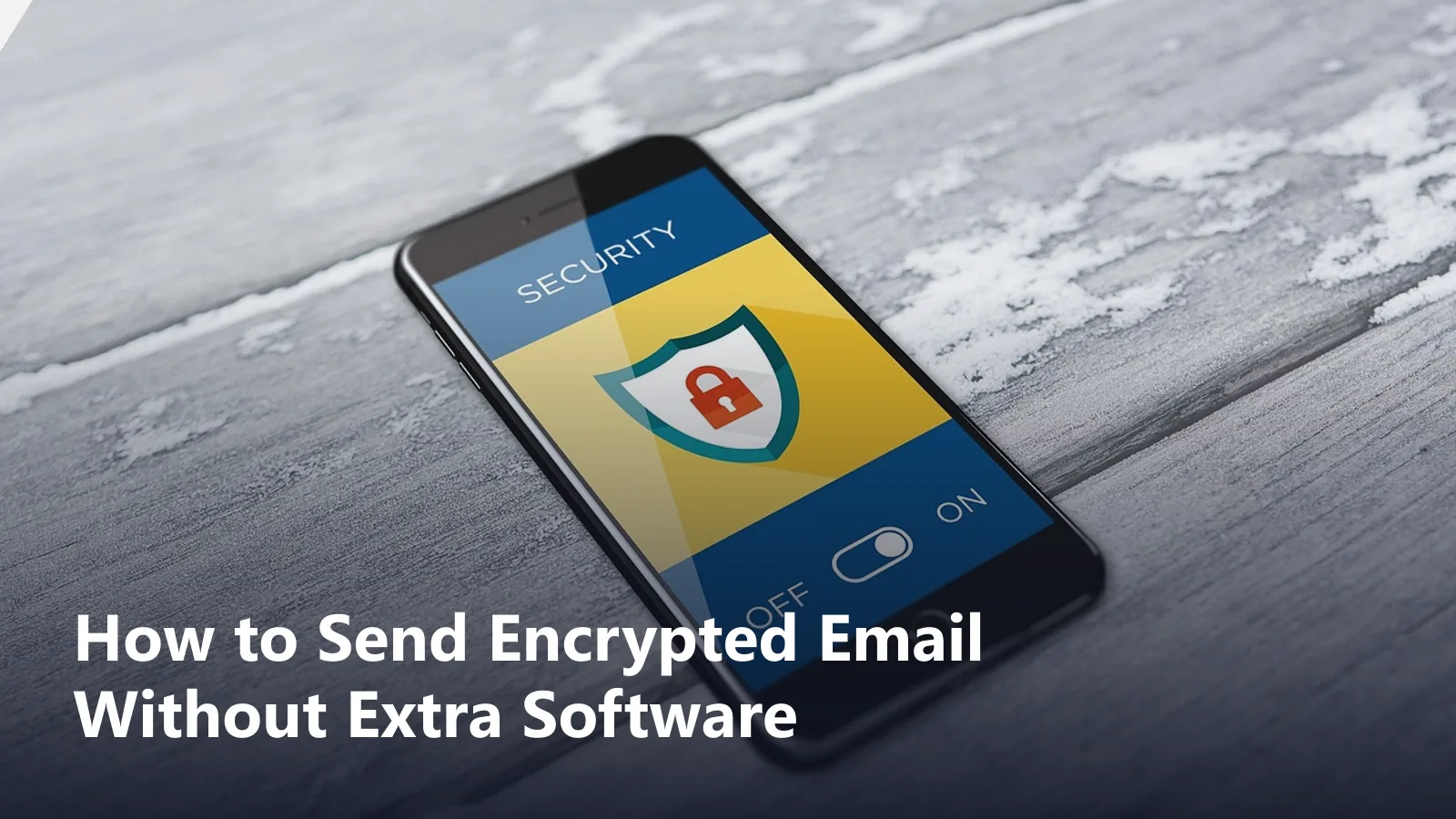
How to Send Encrypted Email Without Extra Software

send encrypted email guide featured image

[mh_key_takeaways]

Sending an encrypted email used to require certificates, keys, and a shared setup between sender and recipient. Native email clients now include options that skip most of that friction, and dedicated services handle it entirely on the server side.

The right method depends on the account you send from, the recipient software, and whether the message contains regulated data like protected health information. Practices and developers who need a HIPAA-safe path can look at a secure email service that sits behind Gmail or Microsoft 365 without extra client software.

This guide walks through the native encryption steps for Gmail, Outlook, iPhone Mail, and code, and shows where each option fits. It also covers the recipient experience, which is the part that most often decides whether an encryption workflow gets used or ignored.

Gmail confidential mode is a starting point, not full encryption

Gmail confidential mode is available on every account, including free personal Gmail. Composing a message and clicking the padlock-and-clock icon at the bottom of the window opens the confidential mode panel.

Confidential mode sets an expiration date, blocks recipients from forwarding, copying, printing, or downloading the message, and can require an SMS passcode. Google stores the message on its own servers and delivers the recipient a link rather than the full body.

The message body itself is not encrypted end-to-end. Google can read it, and confidential mode alone does not satisfy HIPAA requirements because Google does not sign a business associate agreement for free consumer Gmail.

For paid Google Workspace tenants, S/MIME is available on the Enterprise Plus, Education Standard, and Education Plus plans. The admin enables hosted S/MIME in the Google Admin console, uploads a certificate for each user, and the compose window then shows a lock icon that toggles between signed, encrypted, and both.

External S/MIME requires the recipient to hold a matching certificate, which limits the practical scope to organizations that have already exchanged certificates. For patient communication, most practices use a portal-based service instead.

Outlook uses the Encrypt button on Business Premium and higher

Microsoft 365 Business Premium, Apps for Enterprise, and the E3 and E5 tiers include Microsoft Purview Message Encryption. In new Outlook and Outlook on the web, the Encrypt button appears in the Options ribbon and offers two presets.

The first preset is Encrypt, which locks the message so only recipients with valid credentials can open it. The second is Do Not Forward, which encrypts the message and additionally blocks forwarding, printing, and copying by the original recipients.

External recipients receive a link and open the message in a browser portal after signing in with Microsoft, Google, Yahoo, or a one-time passcode. The workflow is documented in the Microsoft Purview Message Encryption reference.

For a tenant on Business Basic or Business Standard, the Encrypt button does not appear. Options are to upgrade the affected mailboxes, add Azure Information Protection as a per-user license, or layer a third-party encrypted email service on top of the existing account.

Purview also requires the tenant to have signed a business associate agreement with Microsoft before it can be considered HIPAA-covered. That agreement is available at no extra cost on eligible plans but must be requested through the Service Trust Portal.
send encrypted email in article illustration one

iPhone Mail supports S/MIME with a configuration profile

Apple Mail on iOS 17 and later supports S/MIME on iCloud, Exchange, and IMAP accounts. Enabling it requires a personal certificate installed through a configuration profile, either from the organization mobile device management console or a signed .mobileconfig file.

Once the certificate is trusted, the account Advanced settings screen exposes a Sign and an Encrypt toggle under S/MIME. Enabling Encrypt tells Mail to attempt encryption on every outbound message from that account.

The compose screen shows a lock icon next to the recipient. A closed lock means Mail has the recipient public certificate and will encrypt the message. An open lock means the certificate is missing and the message will go out unencrypted.

For clinical staff sending patient information from a phone, S/MIME on iOS works but depends on prior certificate exchange with every recipient. That is often unrealistic for patient-facing mail.

A hosted encrypted email service accessed through the mobile browser or a light native app removes the certificate management step. The same account works from desktop, web, and phone.

C# applications can encrypt mail with System.Security.Cryptography.Pkcs

The .NET standard library ships with S/MIME primitives in the System.Security.Cryptography.Pkcs namespace. The developer loads the recipient X.509 certificate, wraps the message body in an EnvelopedCms container, and encrypts it using the certificate public key.

The resulting binary is packaged into a MIME message with the application/pkcs7-mime content type, then sent through SMTP with SmtpClient or MailKit. Recipients open it in an S/MIME-aware mail client, which decrypts it with the matching private key.

The MimeKit library adds a higher-level Multipart/Signed and Multipart/Encrypted wrapper that handles most of the MIME assembly automatically. MimeKit also supports PGP through the BouncyCastle backend for teams that prefer that path.

For applications that send protected health information, calling a secure email API that encrypts every outbound message server-side is usually faster than building and maintaining certificate code. The BAA is signed at the vendor level and covers every message the application sends.

SSIS packages that need to send encrypted mail from a scheduled data flow can call a script task that runs the same .NET code, or shell out to a PowerShell step that uses the Send-MailMessage cmdlet against a hardened SMTP relay.

[mh_example]

PGP is powerful but rarely the right fit for everyday practice mail

PGP encrypts the message body with the recipient public key and signs it with the sender private key. It has been the standard for security-conscious technical users since the 1990s.

The friction is real. Both sides must generate keys, publish public keys somewhere the other side can find them, and use a mail client with PGP support such as Thunderbird with the built-in OpenPGP module or GPG Suite on macOS.

Web-based Gmail and Outlook require browser extensions like Mailvelope to handle PGP, which adds another moving part and a browser-side keyring the user must protect and back up.

For patient-facing communication, PGP is impractical because most patients do not have keys and will not create them. Portal-based systems bypass the key exchange problem entirely and are easier to explain to non-technical recipients.

For sending encrypted messages between two developers or two security teams, PGP remains an efficient choice, and the OpenPGP working group standard is documented at the IETF.

HIPAA-safe encrypted email needs a signed business associate agreement

HIPAA requires covered entities and their business associates to sign a business associate agreement before sharing protected health information. That agreement must be in place before any email service can be considered HIPAA-safe for patient data.

Google Workspace and Microsoft 365 both offer a BAA on eligible paid plans, but the practice must request and sign it. Free consumer accounts are never covered, regardless of how the mail is encrypted.

The HHS HIPAA guidance explains which providers count as covered entities and when a BAA is required. Any vendor that touches, stores, or transmits PHI on the covered entity behalf falls under the rule.

A dedicated encrypted email service such as Mailhippo includes the BAA in the base plan, so every message sent through the account is covered without a separate request or license upgrade. That removes one of the more common compliance gaps found in small-practice audits.

For practices that want the convenience without changing their existing mail platform, see how to send encrypted emails from any account without adding client software.
send encrypted email in article illustration two

The recipient experience decides whether the workflow gets used

The most secure encryption method fails if the recipient cannot open the message. Every method above has a different recipient experience, and matching that experience to the audience matters as much as the underlying cryptography.

S/MIME and PGP require the recipient to have keys or certificates already set up. Purview and Workspace portal messages require the recipient to sign in or use a one-time passcode.

Portal-based encrypted email services typically deliver a link that opens in a browser, with a passcode sent to the recipient inbox or phone. Patients open it, read the message, and reply through the same secure channel without any account setup.

Front-desk staff, billing, and referring providers each have different tolerance for portal login steps. Testing the full round-trip with a real recipient before rolling the workflow out avoids the most common cause of failed encryption programs, which is that nobody actually opens the encrypted messages.

Practices building a full patient communication stack should also think about the surrounding website. Guidance on security features for healthcare websites covers form handling, SSL, and portal integration alongside encrypted email.

Attachments carry the same encryption rules as the message body

Attachments are the most common source of PHI exposure because staff often paste a scanned document or a lab report into a message without thinking about the transport. The same encryption rules apply to attachments as to the body.

Purview and Google Workspace S/MIME encrypt attachments along with the body when the encryption toggle is on. Confidential mode in free Gmail applies expiration and forwarding limits but does not encrypt the attachment end-to-end.

File size limits are a separate consideration. Gmail caps attachments at 25 MB, Outlook at 20 MB on most tiers, and many portal-based encrypted services support larger files by hosting the attachment on their own storage and delivering a link.

For large medical imaging files, a dedicated secure file transfer service alongside encrypted email is often the right pattern. A single encrypted message can then reference the file link and include the passcode.

Verifying that attachments actually arrive encrypted is worth doing during initial rollout. Sending a test message to a personal address on a different provider surfaces any downgrade to plain text.

[mh_protip]

Automation and shared inboxes need a different setup

Scheduled reports, appointment reminders, and billing notifications sent from an application or a shared inbox cannot rely on a human clicking Encrypt in the ribbon. They need a policy or an API that encrypts every outbound message automatically.

Microsoft Purview supports mail flow rules that apply encryption based on the sender, recipient, subject, or content. A rule can encrypt every message going to a specific insurance carrier or every message from a specific mailbox.

Google Workspace has similar content compliance rules under Apps, Google Workspace, Gmail, Compliance in the Admin console. Rules can trigger S/MIME encryption or route the message through a third-party gateway.

For custom applications, a secure email API removes the rule complexity by encrypting every message at the transport layer. The application calls a single endpoint and the vendor handles the compliance mechanics.

Common patterns worth automating include appointment reminders with clinic name and date only in the plain-text body and the full detail behind a secure link, and billing statements delivered through a portal link rather than a raw PDF attachment.

Auditing what you actually send matters more than the theory

Every encrypted email program should include a periodic audit of the sent folder against the encryption logs. The point is to confirm that messages containing PHI actually went out encrypted, not that the option was available.

Microsoft Purview reports show which messages triggered the Encrypt policy and which recipients opened them. Google Workspace audit logs show S/MIME activity and portal opens.

A monthly review that samples a handful of outbound messages catches the common failure modes early. Common findings include messages sent from a mobile client that skipped the encryption step, messages CC-ed to personal addresses, and forwarded threads that dropped the encryption header.

The NIST SP 800-177 Rev. 1 Trustworthy Email guidance covers the technical controls that support this kind of audit, including DKIM, DMARC, and TLS reporting.

Practices that want a shorter path can use encrypted email as a single-vendor service that logs every message, portal open, and reply against the account, which shortens the audit to a single report.

Picking a method comes down to the recipients and the volume

For internal mail between employees on the same tenant, S/MIME or Purview Do Not Forward is the low-friction path because everyone already has the required setup.

For mail to patients, referring providers, and insurance carriers, portal-based encryption avoids the certificate exchange problem. Recipients get a link and read the message without installing anything.

For high volume automated mail from an application, a secure email API is the right layer because it applies encryption once at the transport rather than in every application code path.

Sole practitioners and small practices sending occasional patient mail from a mixed set of devices, including iPhones, get the least friction from a dedicated encrypted email service that includes the BAA and works with any existing Gmail or Microsoft 365 account.

Whichever method fits, the first test is always the same. Send a message to a real recipient outside your organization, confirm they can open it, and confirm they can reply through the same encrypted channel. If any step fails, patient mail will fall back to plain text within days.

[mh_faqs]
TLS vs End-to-End Encryption for Email

Email keeps your practice or business moving. You send schedules, invoices, lab results, reports, and much more. Some of that information should stay private from everyone except the sender and the reader.

Two common protection methods appear in security settings and sales pages. One is TLS. The other is end-to-end encryption. Many people see those terms and feel unsure about the difference between them.

This guide explains both methods in clear language. It shows what each one protects, where each one falls short, and when you might need both. For a broader overview of protected messaging, you can visit the main page on encrypted email at MailHippo.

Quick answer

TLS protects the path between mail servers. It wraps the connection in a secure tunnel so that people on shared networks cannot easily read the traffic. The message may still sit in plain text on each server at both ends.

End-to-end email encryption protects the message content itself. The sender’s system scrambles the body and often the attachments. Only the intended reader has the key to decrypt that data.

In many setups, you use both. TLS guards the road. End-to-end encryption protects the cargo. If you want a gentle introduction to the bigger topic, you can read MailHippo’s guide on what email encryption is.

What TLS email encryption is

TLS stands for Transport Layer Security. It is a standard way to protect data that moves between two systems. For email, those systems are mail servers that relay messages to one another.

When two servers agree to use TLS, they set up a secure session. Inside that session, the data they send looks scrambled to anyone watching the network. The live traffic is no longer plain text on the wire.

People sometimes refer to this as “TLS email encryption”. That phrase can confuse things slightly. TLS protects the connection, not always the stored message. Once the email lands on a server, its content may be restored to readable form there.

What end-to-end email encryption is

End-to-end email encryption protects the message from one person to another person. The sender’s system encrypts the body and often the attachments before the message leaves their device. The recipient’s system decrypts it only when they open it.

Mail servers in the middle see only encrypted blocks of data. They move the message along, yet they do not see names, notes, or report details inside the body. Staff with access to those servers face the same limit.

This style gives stronger privacy for sensitive content. It fits cases where you want to limit how many systems and people can ever read the message. MailHippo explains this model in more detail in the guide on end-to-end encryption for email.

The biggest difference between TLS and end-to-end encryption

TLS focuses on the journey. It makes the road between servers harder to spy on. End-to-end encryption focuses on the message itself. It keeps the content scrambled for most of the journey and often during storage.

With TLS alone, providers at each end may still read and scan the message. With end-to-end encryption, even the provider often cannot see the content in clear text. Only the sender and allowed recipients have that view.

Both methods use strong math. They solve different parts of the problem. Knowing that a split helps you decide what level you need for your own email.

How TLS protects email

Protection during transfer

When your mail server connects to another server, it can offer TLS. If the other side agrees, both servers perform a short handshake. They agree on keys and methods for that session.

After the handshake, the servers send data through the TLS tunnel. Anyone who taps into the network between them sees scrambled traffic. They do not see the email’s live content in plain text.

This step greatly helps on shared and public networks. It cuts down on simple spying attacks that watch traffic on routers and switches.

What mail servers can still access

TLS ends at each server. Once the data arrives, the server decrypts the TLS layer so it can look at the email and decide what to do next. That might mean spam checks, virus scans, or routing to a mailbox.

At that point, the full message may sit in readable form on the server. Staff with deep access can see it. Attackers who breach that server may see it too. The TLS tunnel no longer shields the content there.

So TLS helps protect messages during transfer. It does not always hide them from providers or from all kinds of breaches.

Why do many email services use TLS

TLS works well at the server level. Providers can turn it on once and gain benefits for millions of users. It does not require every single user to change habits or install tools.

That ease leads to wide use among large providers. Google, Microsoft, and many others use TLS by default when communicating with peers that support it. The result is a large share of email traffic that is harder to spy on at the network level.

This broad support makes TLS a useful base layer. Many teams then add end-to-end encryption on top for their most sensitive email.

How end-to-end encryption protects email

Protection from sender to recipient

End-to-end encryption starts on the sender’s device or in their secure portal. The software takes the message body and any chosen attachments. It runs them through an encryption process before the message leaves.

The encrypted content travels across networks and through servers as a block of coded data. Only when it reaches the reader and passes identity checks does the system decrypt it. That final step often happens in the email app or inside a secure web page.

At no stage in the middle should any server see the plain text. That is the promise this method aims to keep.

Who can read the message?

In a true end-to-end setup, only two sides can read the message in clear form. Those are the sender and the specific recipients. The software ties the encrypted content to their keys or secure accounts.

Mail providers, network staff, and attackers who tap into servers see only encrypted blocks. They might know that a message exists and who sent it. They do not see the actual words or attached reports.

This limited access matches strict privacy needs. It helps clinics, law firms, and finance teams that must lower exposure for every message.

How keys or certificates are used

End-to-end encryption relies on keys or certificates. These are long digital codes that work like locks and keys. Most systems use public keys to encrypt and private keys to decrypt.

The sender’s tool uses the recipient’s public key or certificate to lock the message. The recipient’s private key opens it later. No other key will work. Some services manage these keys for users and hide the details behind simple buttons.

Other tools rely on standards such as PGP and S MIME. MailHippo compares those two choices in the guide on PGP vs. S/MIME for email encryption.

What TLS does well

TLS provides a strong lift in the privacy of data in motion. It makes live traffic on shared networks hard to read. That helps staff who work from home, in clinics, or on public Wi Fi.

Providers can centrally enable TLS across their systems. Users do not need to manage keys or change daily habits. They keep their usual email apps and workflows.

TLS fits especially well for general email traffic where content risk is moderate. It lowers easy wins for attackers without adding friction to every message.

What end-to-end encryption does well

End-to-end encryption shines when content must stay private from nearly everyone. It keeps message bodies and attachments scrambled on servers and during transit. Only intended readers see clear text.

This model supports strict rules around health, legal, and finance data. It reduces the impact of many server-level breaches and rogue admin risks. Even if attackers steal stored messages, they face hard math instead of clean records.

End-to-end encryption builds trust with patients and clients. They gain real assurance that their details do not sit open on every system that handles email.

Where TLS falls short

TLS does not protect messages at rest by design. Content often remains readable on servers once it arrives. Providers may index and scan it for various reasons. That exposure can worry teams with strict privacy needs.

TLS offers only partial protection when one side lacks proper support. If the other party uses an outdated or unreliable mail system, the connection may revert to plain text. Users rarely see that change.

TLS does not limit which staff inside a provider can see content. It protects against network snooping, not against every insider or server breach.

Where end-to-end encryption can feel harder to use

End-to-end setups sometimes need more planning. Keys, certificates, or secure accounts must exist on both sides. Without good tools, it can feel heavy for busy staff and patients.

Some older tools ask users to generate and manage keys by hand. That process can confuse non-technical people. It can slow adoption inside a practice or firm.

Portal-based systems solve much of that, but add an extra click and a login for readers. Most people handle it fine, yet it still adds one more step compared with plain email.

What each method protects

Message body

TLS protects the message body during transfer between servers. Anyone watching the network sees scrambled data instead of the live text. Once the message lands, the body may sit in plain form on the server.

End-to-end encryption protects the message from the sender to the reader. It should remain scrambled on servers and on the wire. Only the ends see it in clear form.

For sensitive content, that difference can matter a lot. One method guards the trip. The other guards the trip and the parking lot.

Attachments

TLS treats attachments and bodies the same during transfer. Everything inside the message travels in a secure session between servers. That helps if someone watches network traffic.

With end-to-end encryption, attachments often gain full content protection too. Files pass through the same encryption process as the body. They remain scrambled on servers and during hops.

Some setups use secure portals and send only links in email. In those cases, both TLS and end-to-end methods work together with portal controls.

Subject line and metadata

Subject lines and metadata such as sender, recipient, and time usually fall outside both TLS and end-to-end protection. Systems use those fields to route and display messages.

TLS hides those fields from simple network watchers. People who tap the wire see scrambled packets, not clear headers. Still, servers at each end see the full header.

End-to-end encryption can include headers in some advanced designs, yet most common tools still leave subject and routing data visible. Good practice keeps sensitive details out of those fields.

TLS vs end-to-end encryption for business email

Business email covers a wide range of content. Some messages hold meeting invites. Others carry contracts or payroll details. Not every email needs the same level of protection.

TLS gives a strong base for all mail. It keeps general traffic safer without changing daily routines. Staff keep their normal clients. IT teams gain better defense at the network level.

End-to-end encryption then comes into play for higher-risk messages. HR updates, legal notes, and financial records benefit from that deeper shield. Many firms blend both methods into one platform.

TLS vs end-to-end encryption for personal privacy

For personal use, TLS helps when you send email over shared Wi Fi or public networks. It lowers the chance that someone nearby can read your messages in flight.

End-to-end encryption goes further. It also hides content from many providers and cloud staff. Only you and the person you write to can see the full message.

People who care deeply about privacy often choose services that focus on end-to-end protection. They accept a bit more setup in return for less exposure.

Can both be used together?

Yes, and that pairing is common. A message can use end-to-end encryption for its content and TLS between servers simultaneously.

In that picture, the message body and attachments remain scrambled from sender to reader. TLS then gives a secure tunnel for the encrypted blocks as they move between servers.

The two methods cover different layers and do not clash. You gain defense on the wire and defense at rest.

When TLS may be enough

TLS may suit email that carries low-risk content. That includes newsletters, routine updates, and messages that hold no personal or private data. A leak in those cases may cause little harm.

Small teams with no exposure to health, legal, or finance data may start with TLS only. They still gain better protection on shared networks compared with older setups.

TLS also serves as a first step in your longer move toward deeper tools. It raises the floor even before you add end-to-end features.

When end-to-end encryption makes more sense

End-to-end encryption fits best when a leak would truly hurt someone. That includes health records, ID details, pay data, and contracts. These messages deserve more than just path protection.

Practices, clinics, law firms, and finance teams often sit in this group. They handle high-value data every day. They must answer to patients, clients, partners, and regulators.

For these groups, TLS still matters, but it is not the final word. End-to-end encryption and secure portals bring protection closer to the actual content.

Common questions

Is TLS the same as end-to-end encryption?

No. TLS protects the connection between servers. End-to-end encryption protects messages between people.

Both use encryption, yet they focus on different points. Many teams use TLS everywhere and add end-to-end encryption for selected messages.

Does TLS protect attachments?

TLS protects attachments during transfer in the same way as the body. Files travel inside the secure session between servers and do not appear in plain form on the wire.

On servers at each end, attachments may remain readable unless additional tools encrypt them at rest. TLS alone does not guarantee full content privacy on storage systems.

Can email providers read TLS-protected messages?

In many setups, yes. Providers need to read messages to spam check, filter, and store them. TLS only protects the path between servers.

End-to-end encryption aims to change that. In that model, even providers that handle the message do not see plain text content.

Does end-to-end encryption hide the subject line?

Often it does not. Many common tools leave the subject in plain text so inboxes can sort and show message lists.

Some advanced systems do hide more of the header. For everyday business use, you should treat subject lines as visible and keep them neutral for private topics.

Read next

If you want a simple story style guide to the whole topic, start with MailHippo’s article on what email encryption is. It links TLS and end-to-end ideas into one picture.

For a closer look at two major end-to-end standards, read “PGP vs. S/MIME for email encryption.” That guide explains how each method works in practice.

To explore end-to-end protection on its own, visit End-to-End Encryption for Email. It shows how strong content protection can fit into daily email use.

What Are Encrypted Emails and How They Actually Work

what are encrypted emails guide featured image

[mh_key_takeaways]

Encrypted emails are messages you cannot read without the right key or credential. The concept is simple. The specific methods, recipient experiences, and edge cases behind it are where confusion starts.

This guide covers what encrypted emails actually are, how Gmail and Outlook handle them, whether they can be forwarded, and how to tell a legitimate encrypted message from a phishing attempt. For senders evaluating an encrypted email service, the recipient experience is often more important than the technical specs.

Read the sections in order. Each one covers a specific question users typically ask.

Encrypted Emails Turn Message Content Into Unreadable Ciphertext

An encrypted email is a message where the content has been transformed into ciphertext that only the intended recipient can decode. Encryption applies at one or more layers of the email delivery path.

Transport encryption using TLS protects the message between mail servers. The message body is readable at the servers themselves but not on the network between them.

Content encryption using S/MIME or PGP protects the message body itself. The message stays encrypted at the recipient mail provider until decrypted by the recipient with a matching key.

Portal-based encryption stores the message on a vendor server and delivers a sign-in link. The recipient authenticates to the vendor portal and reads the message in a browser.

Each method covers different threats. Best practice layers TLS with content or portal encryption rather than relying on transport alone.

Gmail and Encrypted Email Behavior

Gmail encrypts messages automatically for transport but not for content by default. Understanding the difference clears up common questions about Gmail encryption.

Google Workspace uses TLS 1.2 or 1.3 when connecting to receiving servers that support it. Standard consumer Gmail does the same. This transport encryption prevents interception on the network path.

Content encryption in Gmail requires Google Workspace Enterprise Plus for S/MIME. The administrator provisions certificates for users and enables encrypted sending inside the workspace policy.

Add-ons like FlowCrypt and Mailvelope bring PGP-based encryption to any Gmail account. The user installs the browser extension, generates a key pair, and encrypts messages one at a time.

Google Confidential Mode is not content encryption. It adds expiration and access controls but Google retains access to the underlying content. Practices should not treat Confidential Mode as HIPAA-compliant encryption.

what are encrypted emails in article illustration one

Outlook and Encrypted Email Behavior

Outlook supports S/MIME natively across Microsoft 365 Business Premium and higher tiers. The certificate installs into the local certificate store and enables signed and encrypted sending.

Microsoft Purview Message Encryption adds a policy-based layer that triggers on rules configured by the administrator. External recipients receive a portal link and sign in with Microsoft, Google, or a one-time passcode.

Third-party add-ins from Virtru, Mailhippo, and other vendors add another encryption path that works across Microsoft 365 tiers without requiring Business Premium.

Outlook shows encrypted messages with a padlock icon in the header. The message properties confirm the encryption method and certificate details.

Users can verify a sent message was encrypted by checking the Sent Items folder for the same padlock indicator. Related coverage in encrypted emails Outlook covers the specific configuration steps.

Forwarding Encrypted Emails Changes the Encryption Context

Encrypted emails can sometimes be forwarded but the encryption context often changes depending on the method and sender policy.

S/MIME messages forwarded from Outlook typically get decrypted with the original recipient key and re-encrypted for the forward recipient if forwarding is permitted. The forward recipient must have a matching certificate or the message will not decrypt on their end.

Portal-based encrypted messages usually cannot be forwarded because the recipient holds a portal access link, not the underlying content. Some vendors allow the recipient to share the portal link with another user, subject to sender policy.

Sender-set rights management controls decide what forwarding is allowed. Microsoft Purview Message Encryption supports Do Not Forward as a rights template that blocks forwarding entirely.

Practices sending regulated content should default to Do Not Forward and enable forwarding only when the sender explicitly permits it. Blanket forwarding permissions undermine the sender control that encryption otherwise provides.

[mh_example]

Encrypted Email Comparison Across Common Methods

The table below compares four common encryption methods across the fields that decide recipient experience and security posture.

MethodRecipient StepsContent Encrypted at RestForwarding BehaviorTypical Use
TLS Transport OnlyNoneNoFreely forwardableStandard business email
S/MIMECertificate installedYesRe-encrypted per recipientEnterprise between certificate holders
PGPKey installedYesRe-encrypted per recipientTechnical users, journalists
Portal EncryptionClick link, sign inYes on vendor serverUsually blockedHealthcare, finance to external recipients

Real-world deployments often layer TLS with either content or portal encryption. The layered approach covers more threats than any single method alone.

Why You Might Be Getting Encrypted Emails

Recipients often receive encrypted emails without expecting them. The reasons are usually straightforward.

A healthcare provider sending PHI encrypts to protect patient information under HIPAA. Test results, appointment details, and billing statements often arrive encrypted.

A financial services firm sending account details encrypts to protect against fraud and to meet GLBA requirements. Statements, tax documents, and account changes often arrive encrypted.

A legal counterparty sending privileged material encrypts to protect attorney-client privilege. Settlement documents, court filings, and case correspondence often arrive encrypted.

An employer sending HR content encrypts to protect employee records. Offer letters, tax forms, and performance reviews often arrive encrypted.

Legitimate encrypted messages come from known senders and route through recognizable vendors like Microsoft, Google, Mailhippo, Virtru, or Barracuda. Suspicious encrypted messages from unknown senders should be treated as potential phishing.

what are encrypted emails in article illustration two

Phishing Increasingly Mimics Encrypted Email Delivery

Phishing campaigns increasingly use fake encryption portals to harvest credentials. Recognizing the pattern reduces the risk of falling for one.

Fake encrypted email notifications typically arrive from unfamiliar senders and reference a document you did not expect. The link goes to a domain that looks similar to a real vendor but does not match.

The fake portal asks for the email password or a Microsoft account sign-in. Legitimate portals ask for a one-time passcode sent to your address or a sign-in with an existing account you recognize.

The CISA phishing guidance covers common patterns and what to do if you suspect a phishing attempt.

Best practice verifies the sender through a separate channel before clicking any encrypted email link from an unfamiliar source. A phone call to a known number is worth thirty seconds of caution.

Are Encrypted Emails Actually Safe

Encrypted emails are safer than unencrypted emails against interception and provider-side access. They do not defend against every threat.

Phishing attacks that steal mail credentials bypass encryption by giving the attacker legitimate access to the inbox. The attacker sees the plaintext through the same interface as the real user.

Malware on the sender or recipient device captures plaintext before encryption or after decryption. Keyloggers, screen scrapers, and clipboard monitors all bypass the encryption layer.

Weak recipient portal passwords make encryption meaningless. A message encrypted with AES-256 protected by a password of qwerty is not protected in any meaningful sense.

Real security posture layers encryption with multi-factor authentication, endpoint protection, phishing training, and incident response. Each layer covers threats the others miss.

[mh_protip]

Shared Mailboxes and Encrypted Messages

Shared mailboxes complicate encrypted email handling. The complications matter more for regulated content than for general business email.

S/MIME-encrypted messages in a shared mailbox require the mailbox owner or delegated user to have a matching certificate. If the certificate is tied to an individual account, other delegates cannot decrypt.

Portal-encrypted messages in a shared mailbox arrive as notification emails. Anyone with credentials to the portal can sign in and read the content. This model preserves recipient anonymity at the cost of audit clarity.

Best practice restricts encrypted PHI or sensitive content to named individual mailboxes rather than shared ones. The audit trail stays clean, and inadvertent access by delegated users does not happen.

Practices with shared inboxes for reception or billing should route PHI through a named clinical inbox and reserve the shared inbox for non-PHI communication.

Related Encrypted Email Reading

Encrypted emails cover multiple adjacent topics. The companion guides below add depth on specific questions.

Users trying to open a specific encrypted message can review how to open encrypted emails in Outlook and how to view encrypted emails. Both guides cover the recipient-side workflow across common vendors.

Senders configuring encrypted sending in Outlook benefit from encrypting emails in Outlook. The guide covers S/MIME setup and the ribbon controls.

Users comparing encryption providers can review ProtonMail encrypted email for a specific vendor deep-dive. ProtonMail illustrates a pure E2EE approach.

Broader coverage of whether standard email is encrypted at all lives in are emails encrypted. The guide covers the transport-only default across major providers.

Where Redefine Web Fits the Healthcare Email Stack

Encrypted email covers the message pipeline. Website contact forms, patient portals, and marketing platforms carry PHI that must reach the same encryption controls.

A contact form on the practice website that emails PHI to a generic Gmail address bypasses every encryption control the practice buys. The submission arrives unencrypted, and the audit trail does not exist.

Redefine Web builds HIPAA-aware healthcare websites and integrates the forms with encrypted delivery paths. Details on the healthcare marketing agency practice cover the surface area that sits alongside encrypted email.

A closed-loop review across website, forms, email, and portal reduces the risk that a PHI leak lands in an unencrypted channel by mistake.

Mailhippo fits senders that want encrypted email delivery with the BAA, audit logging, and simple recipient experience in one product. The service integrates with existing Gmail or Outlook accounts and keeps the recipient path to a single click for most messages, whether the recipient is on Gmail, Outlook, or another provider. Understanding what encrypted emails are makes the vendor conversation shorter and the buying decision more defensible.

[mh_faqs]

Email Encryption Glossary for Common Terms and Definitions

Email encryption can sound like a wall of jargon. If you run a practice, clinic, or small firm, you do not want a textbook. You want clear meanings in plain English.

This glossary keeps the language simple. You can scan it, dip into single terms, and come back when a new phrase pops up. For a broad, non-technical overview of the topic, you can visit MailHippo’s main guide on encrypted email.

Why this glossary helps

Email and privacy tools often come with long terms that vendors throw around. Terms such as TLS, S/MIME, and public key appear on sales pages and in audit reports. Many people nod but do not feel fully sure.

This glossary gives short, direct definitions for those phrases. Each term uses simple language and a real-world context. That makes it easier to speak with IT staff, vendors, and auditors.

You can keep this page open while you read other guides. When you meet a new term, scroll here, read a few lines, and move on with more confidence.

Core email encryption terms

Email encryption

Email encryption is a way to protect email content with strong math. The message body and often the files turn into scrambled data that only certain people can read. The goal is to keep private information safe during sending and storage.

You still use normal email addresses and inboxes. The protection sits around the text and attachments. For a deeper guide, see MailHippo’s article on what email encryption is.

Encrypted email

An encrypted email is an individual message that has been encrypted. Its body and often its files no longer sit in plain text. Only people with the right keys or portal access can see the real content.

Mail servers move the message as usual. They see scrambled data instead of readable text. This makes stolen copies far less useful to attackers.

Secure email

Secure email is a broad term for email that operates within a safer environment. That setup may include spam filters, virus scanning, strong passwords, and sometimes encryption. The exact mix can differ from one provider to another.

Some services claim to offer “secure email” but do not encrypt every message end-to-end. Others combine strong content protection with account and device safety. It helps to ask what “secure” means in any given product.

Encrypted message

An encrypted message is any digital message where the content is scrambled. In this glossary, the focus stays on email. The same idea can apply to chat tools and file sharing.

The key point is that the text no longer appears clearly during transmission or in storage systems. Only people with matching keys or passwords can turn it back into readable text.

Encrypted attachment

An encrypted attachment is a file that travels in a protected form. It may be encrypted by the mail system, along with the email body. It may be a password-protected document that you attach.

In both cases, the file content stays scrambled until the right person opens it with a key or password. This matters a lot for reports, scans, and contracts that carry sensitive data.

Encryption methods

TLS

TLS stands for Transport Layer Security. It protects the link between mail servers, preventing people on shared networks from easily reading traffic. You can picture it as a secure tunnel for data in motion.

Most large email providers use TLS when they talk to each other. That works without extra steps from users in many cases. TLS mainly helps during transit, not always when messages sit in mailboxes.

End-to-end encryption

End-to-end encryption protects a message from one user to another user. Only the sender and the intended reader hold keys that can open the content. Mail servers in the middle move encrypted blocks and do not see the plaintext.

This model gives strong privacy for sensitive messages. It suits health, legal, and finance teams that handle high-risk data. MailHippo explains this further in the guide on TLS vs. end-to-end encryption for email.

PGP

PGP means Pretty Good Privacy. It is a long-standing standard for encrypting emails and files. Many privacy-minded users and some technical teams still rely on it.

PGP uses public and private key pairs. People share their public keys so others can send them encrypted email. They keep their private keys secret, so only they can open those messages.

S MIME

S MIME stands for Secure or Multipurpose Internet Mail Extensions. Many companies and health systems use it with email clients such as Outlook and Apple Mail. It builds on digital certificates that link keys to people or roles.

S MIME can encrypt email content and add digital signatures. A signature proves who sent the message and that nobody changed it during the trip. IT teams often manage certificates behind the scenes for staff.

Access and identity terms

Public key

A public key is a digital code that you can share safely. Other people use it to lock messages so only you can open them. It works as one half of a key pair.

When someone sends you an encrypted email, their system may use your public key. That step ties the message to your matching private key. Sharing a public key does not give anyone the power to read your messages.

Private key

A private key is the secret half of a key pair. Your device or secure account stores it. Only this key can open messages locked with your public key.

Email programs and portals use your private key during decryption. You normally do not see the key itself. Keeping this key safe is central to strong email protection.

Passphrase

A passphrase is a longer form of a password. It often uses several words in a row. People use passphrases to protect private keys or password-protected files.

Longer phrases are harder to guess or crack than short passwords. They still need to be easy enough for you to type and recall. A mix of length and variety gives better safety.

Certificate

A certificate is a digital document that proves identity for a key or system. In email, S MIME certificates link public keys to real users or departments. Trusted authorities issue these certificates.

Email programs can verify certificates to determine whether a message truly came from a named sender. They can also use them to find keys for encryption. Certificates make large-scale key use easier to manage.

Authentication

Authentication is the process of proving who you are in email and portals; it often means entering a password or code or using a sign-in app. Strong authentication helps keep accounts in the right hands.

Encrypted email tools use authentication to decide who may open a protected message. Without a pass, the system will not reveal the content. This step is the gate before decryption.

Email structure terms

Message body

The message body is the main text of an email. It holds greetings, notes, and all the details you type. In encryption tools, this part usually gains the most direct protection.

When an email is encrypted, the body turns into scrambled data. Only the right key can bring it back to normal words. That keeps private text out of easy reach.

Subject line

The subject line is the short title you see in the inbox list. Many systems keep this line in plain text so they can sort and group messages. Phones often show it in alerts.

This means subjects can leak more than people expect. For private topics, use short neutral subjects and keep real detail in the body. Encryption then has more to protect.

Metadata

Metadata is data about data. An email includes the sender and recipient addresses, times, and routing steps. Systems use metadata to move messages and track delivery.

Many encryption tools do not hide metadata. Someone with deep access can still see who talked to whom and when. They cannot read the message content from metadata alone.

Header

An email header is a block of technical lines at the top of a message. Normal inbox views hide most of it. The header holds routing data, server names, and other delivery details.

IT staff read headers to trace spam or delivery issues. Encryption usually focuses on the body and attachments, not on every field in the header.

Attachment

An attachment is a file that travels with an email. Common examples include PDFs, Word documents, spreadsheets, and images. Attachments often carry the most sensitive information.

Encrypted email tools can protect attachments by scrambling them along with the email body. Some systems replace attachments with secure download links to a portal.

Security and delivery terms

Encryption in transit

Encryption in transit protects data while it moves across networks. In email, this often means TLS between servers. The idea is to stop people on shared links from reading traffic.

Transit protection helps with open Wi-Fi and older network gear. It does not always protect messages once they are in mailboxes at both ends.

Encryption at rest

Encryption at rest protects data stored on disks or in cloud storage. When email content is encrypted at rest, the data sits on servers in scrambled form. Decryption happens only when a user opens it.

This step lowers the damage from stolen drives or some server breaches. Real setups can vary, so it helps to ask how a provider handles storage.

Secure portal

A secure portal is a website where people read protected messages and files. The email they receive often holds only a link to the portal, not the full content.

Recipients click the link, sign in, and view encrypted content inside the site. Portals work well when senders need to reach many outside contacts who use mixed email systems.

One-time passcode

A one-time passcode is a short code that is valid for a single login or action. Encrypted email tools often send this code by text or generate it on screen.

The user enters the code to open a protected message. After use, the code expires. This step adds safety, since stolen emails alone are not enough to gain access.

Password-protected file

A password-protected file is a document that requires a password to open. Common examples are locked PDFs or office documents. The file carries its own small layer of encryption.

People often share such files by email and send the password through another channel. This method helps when a fully encrypted email is not available. MailHippo covers this in the guide on password-protected file sharing.

Privacy and risk terms

Data privacy

Data privacy refers to the right of people to keep their personal information from being broadly exposed. Email encryption supports data privacy by hiding sensitive content from extra eyes.

Good privacy practice looks at collection, sharing, and storage, not just sending. Encryption forms one of several tools that together protect data.

Sensitive information

Sensitive information is data that can harm someone if exposed. Examples include health records, ID numbers, pay data, and legal details. Many laws treat this type of data with special care.

An encrypted email is often used when sensitive information must be moved by email. It lowers the impact if a message is intercepted or a mailbox is breached.

Confidential message

A confidential message should stay between a limited group. The term describes intent rather than a specific technology. Some tools add “confidential” labels inside email platforms.

Confidential messages are safer when they use encryption and tight access controls. Labels alone do not protect content.

Phishing

Phishing is a type of scam where fake messages try to trick people into sharing passwords or clicking on harmful links. These messages often pretend to be from banks, cloud services, or bosses.

An encrypted email does not stop phishing on its own. Spam filters, training, and safe habits play a key role here. Encryption is more effective once a real message exists.

Message forwarding

Message forwarding sends a copy of an email to a new address. People use it to loop others into a conversation or to pass on information.

With encrypted email, forwarding might send only a link or a shell, not the full content. New readers may still need the right access to open it. Forwarding plain text from a decrypted view removes that protection.

Business and compliance terms

HIPAA-compliant email encryption

HIPAA-compliant email encryption refers to email tools and configurations that comply with the privacy rules under HIPAA in the United States. HIPAA sets high expectations for how health data moves and sits in systems.

Email alone does not make you compliant. Policies, training, and contracts all matter. Encryption helps you meet rules for data in transit and at rest. MailHippo has a full guide to HIPAA-compliant email encryption for health teams.

Secure email for healthcare

Secure email for healthcare is an email that fits the needs of clinics, practices, and hospitals. It must protect patient data, support staff workflows, and line up with health privacy rules.

Such systems often blend encrypted email, secure portals, and strong access controls. They aim to be simple enough for both patients and busy clinicians. MailHippo explains this in secure email for healthcare teams.

Secure email for legal teams

Secure email for legal teams focuses on client confidentiality and case files. Lawyers share contracts, filings, and advice that must stay private. Email systems for this field often add logging and retention controls.

Encryption helps protect client messages and large bundles of documents sent to courts or other parties. Access tracking helps firms show who saw what and when.

Secure email for finance teams

Secure email for finance teams relates to banks, advisors, and internal finance staff. They handle account numbers, tax files, and pay data.

A good setup protects statements, forms, and approvals with encryption and strong sign-in. It may link to secure portals for file sharing and e-signature tools.

How to use this glossary with the rest of the guide

You can treat this page as your sidekick while you read other articles. When a term like PGP or certificate appears, jump back here, read the short definition, and then return to your main article.

If you want a structured introduction before you dive into the terms, start with MailHippo’s explainer on email encryption. Then keep this glossary open for quick checks.

Health teams that focus on patient data can pair this page with the guides on HIPAA-compliant email encryption and secure email for healthcare teams. That trio covers both words and real practice.

Common questions

What is the difference between secure email and encrypted email?

Secure email covers the entire email setup. It covers spam filtering, login safety, storage, and sometimes encryption. An encrypted email describes how a single message is scrambled so only certain people can read it.

A service can be secure in many ways and still send some messages without strong encryption. The best setups blend both system safety and content protection.

What does an encrypted message mean?

An encrypted message is one in which the content has been converted into coded data. A key or password is needed to turn it back into readable text.

In email, this usually applies to the body and attachments. The idea is to reduce the number of people and systems that can see the real content.

Is TLS the same as end-to-end encryption?

TLS and end-to-end encryption both use strong math, yet they protect different parts of the path. TLS protects the link between servers, so traffic on the wire is harder to read. End-to-end encryption protects messages from one user to another, even while they sit on servers.

Many services use TLS by default. Fewer offer full end-to-end encryption for every message. MailHippo’s guide on TLS vs. end-to-end encryption for email explains this split in more depth.

Does email encryption? cover attachments?

In many modern tools, yes. Email encryption often scrambles attachments along with the body. The files then travel and rest on servers in encrypted form.

Some setups move files into secure portals and instead place links in the message. In both plans, the file does not sit in plain view for every system that touches the email.

Read next

If you want a clear, story-style overview of the whole topic, read MailHippo’s guide on what email encryption is. It links many of these terms into one flow.

Health teams that handle patient data every day can go deeper with HIPAA-compliant email encryption. That article connects the glossary terms to real rules and audits.

For a broader look at safe communication in clinics and hospitals, visit secure email for healthcare teams. It shows how encryption, portals, and processes fit together in daily care.

Smarsh Email Encryption Explained for Compliance Teams

smarsh email encryption guide featured image

[mh_key_takeaways]

Smarsh email encryption is one part of a wider compliance platform rather than a standalone encryption product. Firms in financial services, healthcare, and insurance use it when they need encryption, archiving, and supervision under one contract.

This guide covers what Smarsh encryption actually does, how the platform is set up, and when a lighter encrypted email service covers the same compliance ground with less overhead. Comparing honestly matters because the fit varies with firm size and use case.

The audience for this article is a compliance officer, IT lead, or practice manager evaluating Smarsh against alternatives. The details focus on functional behavior rather than sales positioning.

What Smarsh email encryption actually is

Smarsh is a communications compliance company that acquired Actiance in 2017 and expanded through further acquisitions to become a broad archiving and supervision vendor. Email encryption sits inside the Smarsh Professional Archive and Enterprise Archive product families.

The encryption piece is not sold as a standalone product for most customers. Firms that buy Smarsh for encryption alone are rare. The typical purchase includes archiving, supervision, and encryption together to satisfy a regulatory obligation that spans all three.

Transport encryption uses TLS 1.2 or higher between mail servers. Message-level encryption uses a portal delivery model where the recipient reads the message inside a Smarsh-hosted web view after authenticating with a one-time passcode.

The architecture is designed for compliance-heavy environments where messages must be retained, searchable, and reviewable by a supervisor. Encryption alone does not require this depth of infrastructure, which explains the fit question for smaller firms.

Which regulations Smarsh encryption is designed to satisfy

The primary compliance drivers for Smarsh customers are FINRA Rule 3110, SEC Rule 17a-4, and HIPAA. Each of these regulations imposes obligations that extend beyond encryption itself.

  • FINRA Rule 3110 requires broker-dealers to supervise associated persons and review certain communications
  • SEC Rule 17a-4 requires certain records to be retained in a non-erasable, non-rewritable format for defined periods
  • HIPAA requires encryption of protected health information in transit and at rest, plus audit logging and access controls
  • State privacy laws such as CCPA add breach notification and data subject rights obligations on top of federal rules

A pure email encryption service covers HIPAA on its own. Adding supervision and non-rewritable archiving is what makes Smarsh a fit for a broker-dealer rather than a therapy practice.

Compliance officers evaluating Smarsh should map their specific regulatory obligations against the platform’s features rather than buying the full stack by default. A single-rule requirement rarely justifies the full stack.

smarsh email encryption in article illustration one

Smarsh email encryption setup end to end

Smarsh onboarding is not a self-service signup. A prospective customer talks to a sales engineer, scopes the deployment, and works with a Smarsh implementation team through provisioning.

The customer connects their email platform to Smarsh through mail flow rules on Exchange Online, Google Workspace, or on-premises Exchange. The connection routes outbound messages through Smarsh gateways for policy inspection.

Encryption policies are defined using keyword lists, sender groups, subject line patterns, or attachment content matching. A common example is triggering encryption on any outbound message containing an account number pattern or specific medical terminology.

Once policies are active, supervisors are configured for review queues, archive retention is set to match the regulation, and users are onboarded. A typical mid-sized firm rollout runs four to eight weeks. Microsoft’s own Exchange mail flow rule documentation is published in the Microsoft Exchange documentation.

Accessing a Smarsh encryption account as an end user

Two different login experiences exist. Firm employees log into a Smarsh admin portal to manage archives, run searches, or handle supervision queues. Message recipients log into a separate portal to read encrypted messages.

Firm users receive credentials from their internal compliance administrator during onboarding. Password resets and access changes are handled through the firm’s admin, not through Smarsh support directly. This model protects segregation of duties.

Message recipients receive an email notification with a secure link. Clicking the link opens a login prompt on the Smarsh portal domain. First-time recipients set a passcode. Return recipients enter the credentials they set previously.

Recipients who lose the passcode can request a reset from the same portal. The reset flow uses email verification back to the original recipient address, which is the standard model for portal-based encrypted delivery across most vendors.

[mh_example]

How Smarsh compares to lighter encrypted email services

The comparison matters most for practices that need encrypted email without the wider supervision and archiving stack. The tradeoffs are real, and neither option is universally better.

CapabilitySmarshDedicated encrypted email service
TLS transport encryptionYesYes
Portal-based message encryptionYesYes
FINRA-grade archiving and supervisionYes, core featureNot the primary use case
Business associate agreement for HIPAAYes, on requestYes, in base subscription
Typical onboarding timeFour to eight weeksSame day to one week
Fit for solo practice or two-person firmHeavy for the use caseWell-matched

A broker-dealer that must supervise communications across email, chat, and social media benefits from Smarsh as one contract covering all channels. A four-clinician therapy office that only needs encrypted email to patients does not.

The email encryption service category has matured to the point where dedicated products handle HIPAA well without archiving depth that a small practice will never use.

Smarsh email encryption reviews from compliance teams

Reviews from Smarsh customers cluster around a few consistent themes. The archiving and supervision are strong. The encryption is a supporting feature rather than a headline capability. Support quality depends on the tier.

Broker-dealers and registered investment advisers give positive reviews on the ability to search across email, chat, social, and voice channels from one interface. FINRA examiners are familiar with the platform, which reduces friction during exams.

Healthcare customers on the mid-market end of the range report solid HIPAA coverage. Smaller practices sometimes report that the platform’s breadth is more than they need for encrypted patient communication alone.

Onboarding time is the most common negative theme in reviews. A multi-week implementation is normal for a compliance platform of this scope, but it can be a surprise to teams expecting a faster start.

smarsh email encryption in article illustration two

Deliverability and spam concerns with portal-based encryption

Portal-based encryption sends the recipient a notification email with a link to a secure portal. This model is standard across Smarsh, Microsoft Purview Message Encryption, and most enterprise-grade encrypted email services.

The deliverability question is whether the notification lands in the recipient inbox. Aggressive spam filters on the recipient side occasionally flag portal notifications because the message is short, contains a login link, and comes from a domain the recipient may not recognize.

The fix is on the recipient side. A mail flow rule that allowlists the Smarsh notification domain resolves the flagging. Firms with a large recipient base sometimes publish a one-page guide for external counterparties explaining the setup.

Sender-side deliverability issues almost always trace back to DMARC, SPF, or DKIM misconfiguration on the customer’s own domain. The National Institute of Standards and Technology publishes email authentication guidance in NIST SP 800-177 Rev. 1.

Signing the business associate agreement for HIPAA coverage

Healthcare customers using Smarsh for HIPAA-covered communications need a signed business associate agreement in the compliance file. Smarsh signs BAAs with covered entities, but the process is not automatic on sign-up.

The BAA is requested through the Smarsh account team during onboarding. The signed document is returned to the customer for records retention. HIPAA does not accept a BAA that is only stored on the vendor’s side.

The HHS Office for Civil Rights publishes a sample BAA at HHS.gov sample BAA provisions. Vendors typically use their own template that covers the required clauses.

The BAA is the legal piece. The technical piece is configuring mail flow rules that force encryption on any outbound message containing protected health information. Both pieces are required for HIPAA coverage, not just one.

[mh_protip]

Integrating Smarsh with Microsoft 365 and Google Workspace

Most Smarsh customers run either Microsoft 365 or Google Workspace as their primary mail platform. Both platforms integrate with Smarsh through mail flow connectors and journal rules.

On Microsoft 365, the connector routes outbound messages through Smarsh for policy inspection, and a journal rule copies messages to the Smarsh archive for retention. The Exchange admin center handles the connector configuration.

On Google Workspace, the routing setup uses content compliance rules and an outbound gateway configuration. Google publishes admin guidance in the Google Workspace admin help center.

Configuration errors during the connector setup are the most common source of incident tickets during onboarding. Testing the flow with a small pilot group before rolling out firm-wide catches most issues before they affect production traffic.

When a firm should look at alternatives to Smarsh

Alternatives to Smarsh fall into two groups. Full compliance platforms compete with Smarsh directly for broker-dealer and hospital-scale customers. Dedicated encrypted email services target smaller practices where archiving and supervision are not the primary need.

  • Solo therapy practices, two-person insurance offices, and small clinics rarely need Smarsh-level archiving depth
  • Broker-dealers, registered investment advisers, and hospital systems usually do need it and stay with a platform like Smarsh
  • Firms that only need encrypted patient email save time and cost with a dedicated secure email service that ships the BAA in the base plan
  • Firms that need full-stack supervision across email, chat, social, and voice cannot replicate that with a dedicated encryption service

The decision is not about which platform is better in the abstract. It is about which platform matches the regulatory footprint of the specific firm.

Compliance officers who inherit a Smarsh contract at a smaller organization should review whether the full stack is still needed. Compliance officers at growing firms should confirm the current encryption service will scale to the archiving and supervision requirements the firm is heading toward.

Practical next steps for a compliance officer evaluating Smarsh

Start with the regulatory map. List every rule the firm must satisfy and mark which of them require encryption, archiving, supervision, or all three. This grid drives the platform choice.

Request a scoped Smarsh quote alongside a quote from at least one dedicated encrypted email service. Comparing pricing at the same feature scope is more useful than comparing full-stack Smarsh against encryption-only alternatives.

Run a small pilot before committing. A two-week test with a handful of users on real message flows reveals deliverability, portal experience, and administrator workflow issues that a demo cannot surface.

For healthcare organizations building a website that will collect protected health information alongside encrypted email, the HIPAA-compliant website design considerations pair naturally with the email compliance decision. Both belong on the same risk register.

[mh_faqs]

How an Encrypted Email Looks to Senders and Recipients

An encrypted email can sound abstract. If you run a practice or a small business, you want to know how it looks and how hard it is to use. You care about whether patients, clients, and staff can handle it without getting stuck.

The good news is that an encrypted email often looks very familiar. Your inbox still shows senders and subjects. You still click to open messages. The main change lies in how the content is protected behind the scenes.

If you want a wider view of why people use encrypted email in the first place, you can visit the overview at https//mailhippo.devsite.demoworkspace.xyz/encrypted-email

Quick answer

To you as the sender, an encrypted email usually looks like a normal message with a small lock icon or a “secure” label. You still type your email and press send. Your email tool quietly protects the content as it leaves.

To the recipient, an encrypted email may appear in several ways. It might open inside their regular inbox window. It might open in a secure web page after they click a link. Sometimes they enter a short code to unlock it.

On the surface, much of it looks routine. The real difference is that the text and files are scrambled so that anyone not meant to read them cannot. If you want a deeper feel for what “encrypted” itself means, the guide at https//mailhippo.devsite.demoworkspace.xyz/blog/what-does-it-mean-to-be-encrypted explains that idea in plain language.

What an encrypted email may look like in your inbox

Subject line and sender details

When an encrypted email arrives, your inbox usually still shows the sender’s name and the subject line. You might see “Dr. Patel,” “Accounts,” or a company name, just like any other message. The date and time look the same, too.

Many systems keep the subject line readable. That lets your inbox group messages and show short previews. So you may see a subject such as “Your appointment follow-up” or “Statement for March”.

For private topics, it helps to keep subjects simple and neutral. Treat the subject as a label, not the full story. Save real detail for the protected body of the email.

Security labels, banners, or lock icons

Next to the sender or subject, you may see small signs that the message is protected. Common signs include a lock icon, the word “Encrypted”, or a banner that says the email is secure or confidential.

Different tools use different designs. In some, the lock sits in the subject row. In others, it appears when you open the message. Business platforms sometimes add colored bars across the top with wording such as “This message is protected”.

These signs are visual hints only. The real protection comes from the way the message body and attachments are stored and transferred. Still, those icons and labels help staff spot messages that carry extra privacy.

Message text that opens in a protected view

In some systems, the message opens inside your normal email window, yet the tool treats it as protected in the background. You get a short note at the top indicating whether the message is encrypted or view-only.

In other setups, the email in your inbox is only a shell. It may contain a brief intro and a button such as “Read secure message”. When you click that button, your browser opens a secure page where the real content sits.

Both styles are common. The key point is that the most sensitive parts often do not sit as plain text in your normal inbox view. They sit behind a layer that first checks who you are.

What an encrypted email may look like after you open it

Inline message view

With an inline view, you click the email, and the content appears directly in your email app. At first glance, it feels just like a normal message. You may notice a small lock icon or a notice bar at the top.

Behind the scenes, your app may be using a private key or a stored certificate to decrypt the content. That work happens so fast that you do not see it. You read and reply as usual.

This style is common within a single company or practice, where everyone uses the same email platform and IT team.

Web portal view

With a portal view, the email in your inbox acts more like a ticket than a full message. It often contains a short line of text and a button such as “Open secure message”.

Clicking that button takes you to a secure website. You sign in or confirm your identity, then the full message appears in the browser. You might see a logo, a message window, and buttons for reply and download.

Many health and legal services use this portal style. It lets them share encrypted email with patients and clients who use various email providers.

One-time passcode view

Some systems add a one-time passcode step. The email you receive might say that a code has been sent via text message, or that you need to request one.

You type that code into the secure page or a pop-up window. The system checks the code and then shows the message. The code expires after use, so someone who steals the email later cannot open it.

This extra layer can feel like online banking. It adds one more short step, yet it keeps private details safer from someone who only has the email itself.

How encrypted attachments may appear

Standard file attachments

In many tools, encrypted attachments still look like normal file icons in the message. You see PDF, Word, image, or ZIP icons in the usual spot.

The difference is in how they open. When you click, the system may check your access again or open the file inside a protected viewer. Behind the scenes, the file travels and sits on servers in encrypted form.

From your point of view, you still click a file name to read its contents. The tool adds more protection on the path and in storage.

Protected download links

Some systems do not attach the actual file. Instead, they add a button or link such as “Download secure file” or “View document”.

That link points to a secure portal—the portal controls who can download, how many times, and for how long. If someone forwards the email, the link will not work for the new person unless they pass the same checks.

This style suits large reports, X-rays, or bundles of documents. It keeps heavy and sensitive files out of normal mailboxes.

Password-protected files

You may also see password-protected attachments. These are files that ask for a password when you open them in Word, Excel, or a PDF reader.

The email itself can be encrypted or not. The file carries its own lock. Often, the sender shares the password in a separate message, over the phone, or by text.

Password-protected files can serve as a backup when a fully encrypted email is not in place. For a deeper look at this method, you can read https//mailhippo.devsite.demoworkspace.xyz/blog/password-protected-file-sharing-explained.

Common signs that an email is encrypted

Many tools use a small padlock symbol to show that an email is protected. You might see it next to the subject, inside the open message, or near the address line when you compose.

You may see words such as “Encrypted message”, “Secure email”, or “Protected” in a banner at the top. Business platforms sometimes add a short note stating that replies will also remain encrypted.

When you receive an email notice telling you to click through to a secure portal, that is another strong sign. The short notice usually holds no sensitive details. The real content sits safely on the other side of the login.

Signs that can cause confusion

Secure email banners

Some spam filters add banners that say a message has been scanned or passed security checks. These banners do not always mean the message is encrypted. They may report that a virus scan ran.

Look for wording that talks about “encrypted” or “protected content”, not just “scanned” or “checked”. If a banner seems vague, it may relate only to spam and malware, not to privacy.

Confidential mode notices

Some email services have a “confidential” mode. These messages can expire or be blocked from printing and forwarding. In many cases, the provider can still read the content because it is stored on their own servers.

This mode gives some control over how long a message lives. It does not always match a fully end-to-end encrypted email. The label can make people think the content has stronger protection than it really has.

Password-protected attachments

A password-protected file can give a sense of security even when the email itself is plain. The inbox view and subject line may still reveal a lot. Attackers who steal the mailbox still see who sent what, even if they cannot open the file.

Password locks help at the file level. They do not replace encryption for the email body. Many teams use both together for important documents.

Secure links sent by email

You may receive emails that contain only a link, such as “View your secure document”. The email itself is simple text, not encrypted. The protection lives on the web page the link points to.

This pattern is common for pay stubs, lab results, and large files. It is a valid approach when the portal is well designed. It can confuse people who expect the email itself to look special.

Encrypted email in Gmail

In Gmail, an encrypted email can appear in a few ways. Messages that use standard transport protection may show a small lock in the details panel. Some business setups add extra labels such as “Confidential” or “Internal only”.

Gmail has a confidential mode that can limit forwarding and set expiry dates. That mode does not always mean full end-to-end encryption. The content still lives on Google servers in a form they can process.

When a third-party secure email service sends a portal link, the message in Gmail will often look like a short note with a button. Clicking that button moves you into the secure view in your browser.

Encrypted email in Outlook

In Outlook, encrypted messages often show a lock icon in the message list or next to the sender. When you open the email, you might see a bar stating that the message is encrypted or has restricted rights.

Some Outlook messages open in a special reading pane that blocks copying or forwarding. Others direct you to sign in via a web browser, especially when the sender is outside your organization.

If your company uses S or MIME, Outlook may handle everything inside the app. It quietly uses stored certificates to decrypt messages that arrive for you.

Encrypted email on mobile devices

On phones and tablets, encrypted email may show small lock icons next to subjects or inside open messages. Mobile apps often keep the look very simple because of limited screen space.

When a portal is used, tapping the button in the email opens the secure page in your mobile browser. You then sign in and read the message there. Many portals adapt to small screens, so patients and clients can read on a phone with no trouble.

Some older mobile apps do not directly support certain encryption methods. In those cases, the portal method is often easier for both sides than managing keys on the device.

What parts of the message may still look normal

Sender and recipient addresses

Even when the content is encrypted, the From and To lines usually look the same. They show who sent the message and who received it. Email systems need that data to route messages.

Anyone with access to the inbox or server logs can still see those addresses. An encrypted email keeps the words private, yet it does not hide the basic relationships between people.

Subject line

Subjects often remain in plain text, since inboxes use them for sorting and alerts. You will still see titles such as “Invoice” or “Lab results ready” in your list.

For sensitive matters, keep subjects short and general. You can write “Your report” instead of listing full names or details. The encrypted body can carry the rest.

Time and routing details

Dates, times, and routing hops tend to stay visible in message headers. These fields help support teams track delays and fix delivery issues.

Most users never look at this data, yet it exists. For high-level audits, it shows patterns such as peak times or heavy contact between two parties. It does not reveal the actual content of messages.

Why does an encrypted email look different from one service to another

Each email provider and secure message service designs its own screens. Some keep everything inside the email app. Others rely on web portals. Some show big colorful banners. Others keep signs small and subtle.

Your role and device shape the view as well. Staff on company laptops may see full inline views. Patients on personal phones may see notice emails with simple links.

Because of this variety, it helps to focus on the common signs. Lock icons, clear “Encrypted” labels, and portal links that ask you to sign in are all strong hints that extra protection is in use.

What to do if you are not sure whether a message is encrypted

If you feel unsure about a message, start with the small visual signs. Look for locks, labels, or banners that mention encryption or secure content. Check whether the email sends you to a secure page before you see any private details.

You can ask your IT support or provider to send you a test encrypted email. They can walk you through how it looks in your own tools. A five-minute walkthrough often removes a lot of doubt.

For messages that carry very sensitive data, you can agree on simple rules with your team. For example, you might always send those through a known secure portal with a clear brand and login page.

Common questions

What does an encrypted email look like?

An encrypted email in your inbox usually looks like a normal message with extra signs. You still see the sender, subject, and time. You may see a lock icon or a banner that says the message is protected.

When you open it, you might read it inside your email app, or you might click through to a secure web page. In both cases, the content appears only after the system verifies your identity.

Does an encrypted email change the subject line?

In most systems, no. The subject line stays readable so that inboxes can sort and display it. Encryption normally focuses on the message body and attachments.

So the subject still needs care. Avoid full names, ID numbers, and diagnoses in that field. Place those details in the body instead, where encryption can help.

Do encrypted attachments look different?

Encrypted attachments often look like normal file icons. The file names and types appear as usual. The difference lies in what happens when you click.

Some tools open the file in a secure viewer or download it only after a quick access check. Until then, the file is stored in encrypted form and cannot be read directly on the server.

Can a secure email look the same as an encrypted email?

Secure email and encrypted email sometimes use the same screens and icons. A message can be part of a secure email system yet still travel without full content encryption. In other cases, a truly encrypted email may show only a simple lock.

The labels alone do not always tell the whole story. That is why many people look at the actual method in use, not only the word “secure”. If you run a practice or firm, your IT partner can explain which style your setup uses today.

Read next

If you want to understand the idea of “encrypted” beyond email, the guide at https//mailhippo.devsite.demoworkspace.xyz/blog/what-does-it-mean-to-be-encrypted gives a clear, friendly overview.

To learn how to send this kind of message yourself, step by step, you can read https//mailhippo.devsite.demoworkspace.xyz/blog/how-to-encrypt-an-email.

For files that need their own lock, even outside email, see https://mailhippo.devsite.demoworkspace.xyz/blog/password-protected-file-sharing-explained. That article explains password-protected file sharing in simple terms.

How to Encrypt an Email in Outlook via the Subject Line

how to encrypt email in outlook subject line guide featured image

[mh_key_takeaways]

The subject-line encryption trigger in Outlook is not a client feature. It is an Exchange mail flow rule that runs on the tenant side. Outlook itself sends whatever the user types. The encryption happens after the message leaves the client and hits the server rule.

This guide covers the exact setup, the plan requirements, the keyword patterns that work best, and the failure modes to watch for. For practices without Microsoft 365 plans that include Purview Message Encryption, a dedicated encrypted email service handles the same workflow without any tenant configuration.

The intent is a working setup, not a theoretical option. Administrators can follow the steps and verify each item.

The Trigger Lives on Exchange, Not in Outlook Itself

Outlook desktop, Outlook on the Web, and Outlook mobile do not scan the subject line for a keyword. The client sends whatever the user typed to the Exchange side. The rule that inspects the subject and applies encryption runs on Exchange after the client hands off the message.

That architecture matters for two reasons. First, the same rule applies regardless of which Outlook client the user composed in. Second, the client cannot report whether the rule fired, so verification requires checking the sent side or the message trace log.

The rule is called a mail flow rule in Exchange Online and a transport rule in on-premises Exchange. Both terms describe the same mechanism. Administrators create the rule once and it applies tenant-wide until disabled.

The Microsoft documentation on mail flow rules covers the underlying framework. The specific encryption action requires a plan that includes Purview Message Encryption on the tenant.

Verify the Plan Includes Purview Message Encryption

Before creating the mail flow rule, verify the tenant is on a Microsoft 365 plan that includes Purview Message Encryption. Business Standard, Business Premium, and several Enterprise plans qualify on current SKUs. Basic Business, standalone Exchange Plan 1, and personal Microsoft 365 subscriptions do not.

Check plan eligibility in the Microsoft 365 admin center under Licenses. Cross-reference against the Microsoft product feature matrix, which lists Purview Message Encryption entitlements per plan. The matrix updates when Microsoft changes plan structure, so check it at rule creation time rather than relying on memory.

Attempting to save a mail flow rule with an encryption action on an ineligible plan produces an error pointing to the license requirement. That prevents the rule from silently failing at runtime but does not help staff who assumed encryption was working before the error appeared.

Practices on ineligible plans have two paths. Add the required license across seats through Microsoft, or use a dedicated encrypted email service that provides equivalent functionality without a tenant plan change.

how to encrypt email in outlook subject line in article illustration one

Create the Mail Flow Rule in Six Steps

The rule creation process takes about five minutes for an administrator familiar with the Exchange admin center. The screens have shifted several times over the last few years but the underlying flow stays consistent.

Follow these steps:

  • Sign in to the Microsoft 365 admin center and open the Exchange admin center.
  • Navigate to Mail flow, then Rules.
  • Click the plus icon and select “Apply Office 365 Message Encryption and rights protection to messages”.
  • Give the rule a descriptive name such as “Subject-line encryption trigger”.
  • Set the condition to “The subject or body includes any of these words” and enter your chosen keywords such as secure, encrypt, [secure], and [encrypt].
  • Choose the Encrypt template, save the rule, and enable it.

Some administrators tighten the condition to “The subject includes any of these words” instead of the body match. That prevents accidental encryption on messages that mention the keyword in the body but are not intended to trigger the rule.

Pick Keyword Patterns That Reduce False Positives

The specific keyword pattern matters more than most administrators expect. A bare word like secure fires on legitimate business subjects such as “Secure area badge renewal” or “Please secure the meeting room”. Bracketed tags reduce that noise significantly.

Common patterns in practice fall into three categories. Bare words like secure or encrypt are easy for staff to remember but produce more false positives. Bracketed tags like [secure] or [encrypt] rarely fire by accident because square brackets are uncommon in normal subject lines.

Custom identifiers like [PHI-SEND] or [ENC-HIPAA] work best for practices with formal compliance training. They eliminate false positives entirely but require staff to memorize the exact string.

A rule that fires on multiple variants catches loose staff conventions. Combine the bare word and the bracketed tag in one rule so both work. Document the accepted variants in the staff handbook so new hires learn the convention from day one.

[mh_example]

Comparison of Subject Line Trigger vs Encrypt Button

Both the subject-line trigger and the Encrypt button on the Options ribbon use the same Purview Message Encryption backend. The differences are workflow and enforcement.

AspectSubject line triggerEncrypt button
Where the decision happensServer side via mail flow ruleClient side per message
Failure modeSilent when keyword mistypedNone when user clicks the button
Recipient experiencePurview portal or inlinePurview portal or inline
Setup effortOne mail flow rule per tenantNone, feature is present on eligible plans
Works in Outlook mobileYes, subject travels with the messageYes, in newer mobile versions
Best forBulk staff conventionsIndividual sensitive sends

Most practices run both. Staff who prefer the button use it. Staff who prefer the keyword use that. High-risk lists get default-encrypt coverage through a targeted mail flow rule that fires on the list address rather than the subject.

how to encrypt email in outlook subject line in article illustration two

Test the Rule Before Announcing It

Every new mail flow rule needs testing before staff-wide rollout. The test confirms the rule fires on the intended pattern, produces the expected recipient experience, and does not accidentally encrypt sends that should stay plain.

Send a test message from a mailbox covered by the rule to an external address with the trigger keyword in the subject. Verify the recipient receives a Purview portal notification rather than a plain send. Sign in as the recipient and read the message inside the portal.

Repeat with each keyword variant and each major recipient domain including Gmail, Outlook.com, and Yahoo. Note any variation in the portal experience. Some recipients need to request a one-time passcode. Others sign in with their existing provider account.

Use Exchange message trace under the mail flow admin panel to confirm the rule fired on each test message. The trace shows the rule name and action applied to each message, which is the audit evidence during a compliance review.

Silent Failures Are the Biggest Operational Risk

Subject-line triggers fail silently when the pattern does not match. A typo like “secre” or missing brackets on a tag-style trigger produces a plain send with no error, no warning, and no notification to the sender.

The failure mode is dangerous because staff assume the rule fired based on their intent, not their actual keystrokes. A busy front desk sending 40 messages in a shift can produce several silent failures without anyone noticing until an audit or a breach investigation surfaces the pattern.

Compliance-focused organizations pair the subject-line rule with a data loss prevention rule that scans the body for patient data patterns and applies encryption as a safety net. When the subject-line rule misses, the DLP rule catches. When both rules fire, only one encryption action applies to the message.

The Microsoft DLP documentation covers the pattern configuration. Combining DLP with the subject-line trigger produces a stronger posture than either control alone.

[mh_protip]

Strip the Trigger Tag from the Outbound Subject

The subject line usually travels in cleartext even when the body is encrypted. A trigger word like [secure] or ENC: appears in the recipient inbox alongside the sender name, which reveals the sensitivity of the exchange before the recipient opens anything.

Practices that care about that leak add a second mail flow rule that strips the trigger tag from the outbound subject after encryption fires. The rule looks for the tag and rewrites the subject to remove it.

Order matters. The encryption rule needs to fire before the rewrite rule so the encryption action sees the tagged subject. Mail flow rule priority in the Exchange admin center controls the sequence.

Test the sequence after configuration to confirm the recipient sees the cleaned subject rather than the tag. A rewrite rule that fires before the encryption rule produces a plain send with a clean subject, which defeats the entire purpose.

When Practices Use a Dedicated Encrypted Email Service Instead

The subject-line trigger and the Encrypt button both require a Microsoft 365 plan that includes Purview Message Encryption. Practices on lower plan tiers or on non-Microsoft mail platforms need a different path.

A dedicated encrypted email service layers on top of the existing mailbox and applies encryption to every outbound message by default. There is no keyword to remember, no rule to maintain, and no risk of silent failure through a mistyped trigger.

Mailhippo is a secure email service that works with existing Outlook, Gmail, and Yahoo accounts, applies TLS and client-side encryption to every outbound message, and includes a business associate agreement in the base plan. One brief mention here for administrators evaluating options where the mail flow rule approach does not fit.

The tradeoff between native and dedicated tools usually comes down to license cost, IT staff bandwidth, and the acceptable friction on the recipient side. Both approaches produce a compliant HIPAA email flow when configured correctly.

Related Setup Steps to Verify After Rule Creation

The subject-line trigger is one piece of an encryption program. Several related controls determine whether the trigger produces the intended result end to end.

Verify each item before treating the rule as production ready:

  • The tenant plan actually includes Purview Message Encryption on every mailbox that will use the trigger.
  • The signed BAA with Microsoft covers Exchange Online for the tenant.
  • External recipients on major providers decrypt through the portal without extra setup.
  • Sent items shows a lock icon or encryption indicator on triggered messages.
  • A DLP rule provides backup coverage for sends that miss the subject-line pattern.
  • Staff training documents the exact keyword conventions.

Related reading on how to encrypt an email subject line generally covers the equivalent patterns for Google Workspace and dedicated services. The how to encrypt email in Outlook overview gives broader context on the encryption paths inside the Outlook client.

Healthcare practices building patient communication programs benefit from aligning the encryption layer with the broader site and intake experience. A healthcare marketing agency can help ensure the patient-facing site messaging matches the security posture staff execute on outbound Outlook mail.

[mh_faqs]

What Does It Mean to Encrypt an Email?

Many people hear the phrase “encrypted email” and nod along. Deep down, they still wonder what that really means. If you run a practice or a small business, you want to know one thing. Does this keep my messages safer?

Encrypted email changes how your message is stored and moved. The text and files turn into protected data that only the right people can read. For a bigger overview of secure messaging, you can visit MailHippo’s main guide to encrypted email.

This article explains what encrypted email means in plain language, with no heavy tech talk.

A simple definition

An encrypted email is one in which the message content is scrambled by design. Your email software turns readable text into coded data before it leaves your device. Only someone with the right key or access can turn it back into clear text.

So, an encrypted email is not just “marked secure” in the subject line. The content itself has changed form. Anyone who steals a copy without the right key sees nonsense, not words.

That is the heart of the encrypted email’s meaning. The message still moves through mail servers. It still lands in an inbox or portal. The difference sits inside the body and files.

What makes an email encrypted

The message content is changed into protected data

When you send an encrypted email, your software encrypts the message body. This uses strong maths. The output looks like a block of random characters.

Mail servers carry that block from place to place. They do not see the original text. Staff with deep access to those systems see the same block.

This shift from clear text to coded data is what makes the email encrypted, not just private in a casual sense.

Only approved recipients can turn it back into readable text

For someone to read that coded block, they need the right key or login. Their email tool or secure portal holds that key. When they open the message, the tool turns the block back into normal text.

No key, no clear message. That holds for attackers who grab traffic on a network. It holds for most people inside your provider. It even holds for many admins on the mail servers.

You can think of the key as a digital version of a physical key. Many doors can exist. Only a matching key opens a given lock.

Attachments may be protected, too.

In many systems, encryption applies to attachments as well. Files such as X-rays, reports, and scans undergo the same process as the message body.

Those files then travel and rest on servers in encrypted form. Only when an approved reader opens or downloads them do they return to normal.

Some tools move files into a secure portal but still send an email notice. The link in that notice points to the encrypted files in the portal.

What an encrypted email looks like in practice

From your side, as the sender, an encrypted email often looks almost normal. You write your message, add recipients, attach any files, and click a “secure” or “encrypt” option.

Your software then applies encryption in the background. You might see a small lock icon or a label that shows the message will go out as protected. The rest feels like any other email you send.

From the recipient’s side, the experience depends on the system in use. In a standard email app with built-in support, they open the message and may enter a password or code once. In a portal setup, they click a link in a notice email, sign in, and read the message in a secure web page. If you want to see how that looks on screen, you can read MailHippo’s guide on what an encrypted email looks like.

What the recipient needs to read an encrypted message

To read an encrypted email, the recipient needs the right combination of identity and key. The details vary, yet the idea stays the same.

In some setups, their email app stores a private key or certificate. Logging into the account proves who they are. The app uses that private key to decrypt the message.

In portal-based tools, the person first proves their identity in the browser. That might mean a password, a one-time code, or a known phone number. The portal then uses its internal keys to display the message in plain text to that user only.

In both cases, someone who cannot pass this identity step does not see the message. They may see the notice email or the scrambled block, but not the real content.

What parts of an email can be protected

Message body

The body is the main text you type. In an encrypted email, this part is directly protected. The body is encrypted before it leaves your device.

People who intercept the email without the right key cannot read this text. They see random characters instead of words. That helps for messages that hold names, dates of birth, diagnoses, and other personal data.

Attachments

Attachments often carry the most sensitive details. These include scans, lab results, invoices, and HR records. Many encrypted email tools protect these files as well as the body.

The files then move between systems as encrypted blobs. The recipient’s side only unlocks them when the right person opens or downloads them.

Files sent with the message

Sometimes you do not attach files in the classic sense. You send links to files that sit in a secure portal or drive. Many modern tools can encrypt the link itself or gate access to the linked file.

In those models, the email becomes the notice. The content lives in a protected store. The encrypted link, along with portal controls, determines who can fetch the file.

What parts may still stay visible?

Subject line

Mail systems use the subject line for sorting, searching, and alerts. For this reason, many encryption tools leave the subject in plain text. The subject may still show up on phone lock screens and in server logs.

So even when email content is encrypted, a subject such as “Full medical report for John Smith” can leak more than you want. Short, neutral subjects are better suited to private topics.

Sender and recipient details

Mail servers need to know who sends and who receives each message. Addresses in the From and To fields stay outside the encrypted content. They remain visible.

This means people can still see connections between staff, patients, clients, and partners. They cannot read the content from that data alone, yet they can trace patterns.

Time and routing data

Each message carries dates, times, and routing stamps. Systems use these fields to move email and to diagnose problems. Encryption of the body does not hide these pieces.

Someone with deep access can see when you sent messages, how often, and through which servers. For most teams, that is not a major concern, yet it matters for very high-risk cases.

An encrypted email is compared with a regular email.

A regular email travels in a much more open way. Parts of the journey might use a secure link, yet the content can sit in plain text on mail servers. Staff and attackers with enough access can read it word for word.

Encrypted email changes that story. The body and often the attachments travel and rest in coded form. Only the right key or portal access turns them back into readable text.

Both still use the same email addresses and general tools. The gain sits inside. Regular email offers ease. Encrypted email offers privacy that matches modern risk.

Encrypted email compared with password-protected files

Many people are familiar with password-protected PDFs or documents. They send a normal email, attach a locked file, and share the password in some way. That method protects the file, not the message body.

An encrypted email can protect both the body and the attachments. The whole message becomes a protected unit. That reduces the chance that someone reads the text around the file and guesses what is inside.

Password-protected files still have a place. They help when you move a file through systems that do not support encrypted email. For many teams, the best setup uses both methods where they fit best. MailHippo’s guide on password-protected file sharing covers that topic in more detail.

Common types of encrypted email

TLS

TLS protects the link between mail servers. When two servers agree on TLS, the data that flows between them is encrypted in transit. Attackers on shared networks cannot read it in plain form.

TLS does not always encrypt stored content. After delivery, the email might sit on a server in clear text. Many platforms use TLS by default because it helps a lot with minimal user effort.

End-to-end encryption

End-to-end encryption protects the message from the sender’s device to the recipient’s device. Servers in the middle see only encrypted blocks.

Only the sender and the intended reader hold keys that open the content. This model offers strong privacy for sensitive emails, such as health or legal messages.

PGP

PGP, or Pretty Good Privacy, uses public and private key pairs. People share their public keys so others can send them encrypted emails. They keep their private keys secret.

The sender’s tool uses the public key to encrypt the content. The recipient’s private key decrypts it. Classic PGP can feel technical. Some services hide the complex parts and present a simple screen.

S or MIME

S or MIME uses digital certificates to link keys to people or roles. Many business and health systems rely on it inside Outlook and similar tools.

The sender uses a recipient’s certificate to encrypt an email. The recipient’s mail client uses a private key to read it. S/MIME can add digital signatures that prove who sent the message and that nobody changed it in transit.

Why do people use encrypted email

Privacy

More people care about who can read their messages. Regular email leaves content open to more systems and staff. Encrypted email reduces those extra eyes.

This matters for simple personal chats, travel plans, and ID scans. It matters even more for health and money details.

Work messages

In a practice or office, email carries quotes, invoices, HR notes, and strategy. A single mailbox breach can expose years of history.

Encrypted email turns those records into a harder target. Attackers who steal a store of messages encounter walls of scrambled data rather than neat text.

Sensitive documents

Documents often carry the biggest risk. One misdirected email can send a full report to the wrong place. One stolen backup can expose thousands of files.

Encrypted email protects these files during sending and in many storage setups. It pairs well with portals and strict file access rules.

Regulated data

Health, legal, and finance teams handle data subject to strict rules. Many laws and contracts require strong protection when data is sent.

Encrypted email helps meet those demands. It shows that you treat regulated data with care when it leaves your systems.

What encrypted email does not promise

It does not hide every detail

An encrypted email protects its content and often its attachments. It does not always hide subject lines, addresses, or timing data. People can still see that a message exists and who sent it.

Designing neutral subjects and short recipient lists still matters. These habits work with encryption, not against it.

It does not fix weak passwords.

If someone steals a user’s password, they can log in and open encrypted messages just like the real user. Encryption does not fix that.

Strong passwords, multi-factor login, and careful habits remain important. Encryption adds a layer. It does not replace basic account safety.

It does not stop every security threat.

Malware on a device can read data after decryption. Phishing emails can trick people into sharing login details. Human error can cause a message to be sent to the wrong person.

Encrypted email reduces damage from many attacks. It cannot block everyone. Training and simple checks still play a big part.

How to tell if an email is encrypted

Many email tools mark encrypted messages with a lock icon or a short label. You may see this near the address line or in message details. Some show different lock styles for different levels of protection.

Portal-based systems send a plain notice email with a link. The notice itself holds no private content. The real encrypted message sits behind the link in a secure page.

If you want to see clear examples, you can read MailHippo’s guide on what an encrypted email looks like. That guide includes practical views and simple tips.

Common questions

What does an encrypted email mean?

An encrypted email means the message content has been turned into coded data that only certain people can read. The body and often the files no longer sit in plain text on mail servers.

The goal is to protect privacy and cut the impact of leaks. It changes email from a postcard-style tool into something closer to a locked envelope.

Does an encrypted email protect attachments?

In most modern systems, yes. Encrypted email tools protect both the body and attachments. The files travel and rest in encrypted form and are opened only to approved readers.

Some tools move files into secure portals and send links instead. In both cases, the idea stays the same. Files sit behind a layer of protection, not wide open in every mailbox.

Can an encrypted email be forwarded?

People can forward almost any email. An encrypted email does not always give full access to new readers.

Many systems tie the encrypted content to the original recipient accounts. A forward sends only a link or a shell. New readers still need the right login or key. If someone copies text from a decrypted view into a new plain email, that new message will not stay protected.

Is an encrypted email safer than a regular email?

For content privacy, yes. Encrypted email protects message bodies and files from many more risks than regular email. Attackers who steal traffic or stored messages gain far less.

You still need strong passwords, updates, and training. When you add those pieces, encrypted email becomes a strong part of a safer setup.

Read next

If you want a broader view of this topic, you can read MailHippo’s main guide on what encrypted email is. It links the idea to everyday tasks in a practice or office.

To see real screen examples of protected messages, open What Does an Encrypted Email Look Like. That article shows how encrypted email appears in common tools.

For deeper control over files themselves, explore Password-Protected File Sharing Explained. It walks through safe ways to share documents alongside encrypted email.

How to Send Encrypted Email from Yahoo Mail

how to send encrypted email yahoo guide featured image

[mh_key_takeaways]

Yahoo Mail carries no native encryption button in the web app or the mobile client. That surprises users who assume every major provider offers a one-click encrypt option today. Yahoo does not, and the service is not HIPAA compliant for regulated senders on its own.

This guide covers the three practical ways to send an encrypted email from a Yahoo address: a desktop client with S/MIME, an OpenPGP browser extension paired with GnuPG, or a dedicated encrypted email service that layers on top of Yahoo Mail with a signed business associate agreement.

The intent is a working setup, not a theoretical option. Each section covers the real steps and the friction users hit when they try to make Yahoo carry encrypted mail at any volume.

Yahoo Mail Offers Transport Encryption and Nothing Else Natively

Yahoo Mail uses TLS for server-to-server delivery when the other side supports it. Yahoo also uses HTTPS for the browser session and app connections. Those two protections cover the wire.

The body itself sits in Yahoo storage in a form Yahoo can read. There is no client-side encryption, no S/MIME support in the web interface, and no OpenPGP integration in the compose window.

The Yahoo end-to-end encryption browser extension project announced years ago was quietly shelved before shipping to consumer users. Nothing replaced it. Free and paid Yahoo Mail accounts alike offer identical encryption capabilities today, which is to say only transport protection.

The HHS HIPAA security rule requires body-level encryption or another equivalent safeguard for messages containing electronic protected health information. TLS in transit alone does not meet the requirement without additional controls in the surrounding environment.

how to send encrypted email yahoo in article illustration one

Yahoo Mail Is Not HIPAA Compliant on Its Own

HIPAA compliance for a service that handles patient data requires a business associate agreement between the covered entity and the service provider. Yahoo does not offer a BAA for Yahoo Mail on any tier of the product.

That means a therapy office, dental practice, medical billing service, or any other covered entity cannot use a Yahoo address for clinical email even if the individual users take steps to encrypt outbound messages manually.

The correct path for a HIPAA-covered organization on Yahoo is migration to Google Workspace with the appropriate encryption controls, Microsoft 365 with Purview Message Encryption, or a dedicated encrypted email service that includes a BAA in the base plan.

Personal Yahoo addresses can still be used for non-clinical business correspondence with proper care, but the moment PHI enters the message flow, the practice needs a different platform.

Desktop Clients Add S/MIME Support to Yahoo Accounts

The first workaround for a Yahoo user who needs occasional encrypted sends is a desktop email client with S/MIME support. Thunderbird, Apple Mail on macOS and iOS, and older versions of Outlook all connect to Yahoo through IMAP and support certificate installation.

Set up the Yahoo account in the desktop client using IMAP settings and an app password generated from the Yahoo account security page. Obtain an S/MIME certificate from a public certificate authority like Sectigo, DigiCert, or Entrust.

Install the certificate in the client. Configure the client to sign and encrypt outgoing messages using the certificate. The recipient needs a corresponding certificate installed in their own client to decrypt.

The tradeoff is that Yahoo webmail cannot read the resulting encrypted messages. Staff moving between the desktop client and the web app see mixed results. This approach fits users who send encrypted mail rarely and can commit to the desktop workflow.

[mh_example]

OpenPGP Browser Extensions Encrypt Inside Yahoo Webmail

OpenPGP browser extensions such as Mailvelope let a user encrypt messages inside the Yahoo webmail compose window without switching to a desktop client. Install the extension in Chrome or Firefox, then add the Yahoo Mail domain to its allowlist.

Generate an OpenPGP key pair through the extension. Share the public key with the intended recipients through a separate channel. Import their public keys into the extension so encryption to those addresses is possible.

When composing a message in Yahoo webmail with the extension active, click the extension icon to enter encrypted compose mode. Write the message and encrypt before sending. The message body arrives at Yahoo as a block of ciphertext.

Recipients decrypt using their own OpenPGP client such as GnuPG or a browser extension of their own. The GnuPG project documentation covers the general OpenPGP flow. This approach fits occasional one-to-one exchanges with technically capable recipients, not routine patient communication.

how to send encrypted email yahoo in article illustration two

Dedicated Encryption Services Layer on Top of Yahoo Mail

A dedicated encrypted email service is the lowest-friction option for a Yahoo user who needs encrypted mail regularly. The service acts as a delivery layer that receives the outbound message, applies encryption, and delivers to the recipient through a portal or inline decryption.

Setup takes minutes rather than the hours certificate management demands. The user signs up for the service, connects the Yahoo address as an authorized sending mailbox, and composes through the service interface or a mobile app.

The service handles the business associate agreement, key management, and recipient decryption experience. There are no PGP keys to exchange, no certificates to install, and no desktop client to configure. The recipient sees a familiar portal-based experience.

Mailhippo is a secure email service designed for this profile. It works with existing Yahoo, Gmail, and Outlook accounts, applies encryption to every outbound message, and includes a business associate agreement in the base plan. One brief mention here in case a Yahoo user needs an encryption path that native Yahoo cannot provide.

Recipient Experience Depends on the Method

Each encryption approach produces a different recipient experience. Understanding the differences helps a practice pick the right method for its patient population or client base.

The main patterns are:

  • S/MIME messages show a padlock icon in the recipient client when they have the corresponding certificate installed.
  • OpenPGP messages arrive as blocks of ciphertext until the recipient decrypts through their own OpenPGP tool.
  • Portal-based encryption from a dedicated service delivers a notification with a link the recipient clicks to authenticate.
  • TLS-only sends look identical to any plain email once they land in the recipient inbox.

Portal-based delivery has the lowest recipient friction for one-off exchanges because the recipient does not need any prior setup. S/MIME and PGP require the recipient to have infrastructure in place. For a healthcare practice sending to patients on any device, portal delivery wins on usability.

[mh_protip]

Migrating Off Yahoo Mail for HIPAA Workflows

Practices still using Yahoo Mail for clinical correspondence should plan a migration off the platform. The lack of a business associate agreement makes Yahoo unsuitable for HIPAA workflows regardless of what encryption workaround the users apply.

The migration typically involves picking a new mail platform, moving the domain if the practice used a Yahoo custom domain, updating patient and vendor contact records, and setting up encryption on the new platform before turning off the Yahoo mailbox.

Google Workspace with S/MIME on eligible plans, Microsoft 365 with Purview Message Encryption on Business Premium or above, or a dedicated encrypted email service are the three main destinations. Cost, IT staff availability, and existing tool investments usually determine the choice.

Practices in healthcare benefit from aligning the migration with a broader look at patient communication channels. A healthcare marketing agency can help ensure the patient-facing site and intake flow match the encryption layer sitting behind the mailbox.

Common Yahoo Mail Encryption Mistakes to Avoid

Users setting up encrypted mail on a Yahoo address make several predictable mistakes. Each one produces a policy gap that surfaces during a compliance review or a breach investigation.

The most common are:

  • Assuming TLS in transit qualifies as HIPAA-compliant encryption on its own without a BAA.
  • Installing S/MIME in a desktop client and forgetting that Yahoo webmail cannot read the resulting encrypted messages.
  • Sharing OpenPGP public keys inside the encrypted messages themselves, which recipients cannot use to decrypt those same messages.
  • Using a personal Yahoo address for clinical correspondence when the practice has a HIPAA-covered mailbox available elsewhere.

The related guide on how encrypt email across major platforms covers the equivalent options in Outlook, Gmail, AOL, and GoDaddy Professional Email. That article gives the broader context Yahoo users need when picking a migration destination.

Verify the Encryption Actually Fired Before Trusting It

Every encryption method has a failure mode. S/MIME fails when the recipient certificate is missing or expired. OpenPGP fails when the wrong key is imported. Portal services fail when the sending mailbox loses authorization.

Verification steps that catch failure early include checking the Sent Items folder for a visible encryption indicator, sending a test message to a personal address on a different platform and confirming the portal or ciphertext appears, and reviewing service logs periodically for delivery failures.

A dedicated service usually reports encryption status back to the sender through a delivery confirmation. Desktop clients using S/MIME show a lock icon in the sent message. OpenPGP tools display a confirmation panel after successful encryption.

For a broader look at the security controls that pair with encrypted email in medical environments, see the guide on security features for healthcare websites. Encryption is one control among many, and verification is what makes it credible under audit.

[mh_faqs]